A high school is built to get hundreds of people through the day without letting them all into the same hallway at once. It has rooms for groups, an office for trouble, and a principal accustomed to hearing several versions of how the trouble started. There are worse places to begin rebuilding civilization.
In RED/BLUE, newlyweds Penn and Farrah Fletcher go to a mountain cabin for their honeymoon. Civilization collapses overnight. Vernon High becomes a refuge, and its principal, Augusta, takes on the task of leading the people who gather there.
A cabin and a high school offer two very different kinds of safety. A cabin puts distance between you and everyone else. A school asks you to share the building with people you might never have chosen to spend an afternoon with, much less depend on. Suddenly the person whose habits drive you up the wall might also be the person you’re relieved to see coming back through the door.
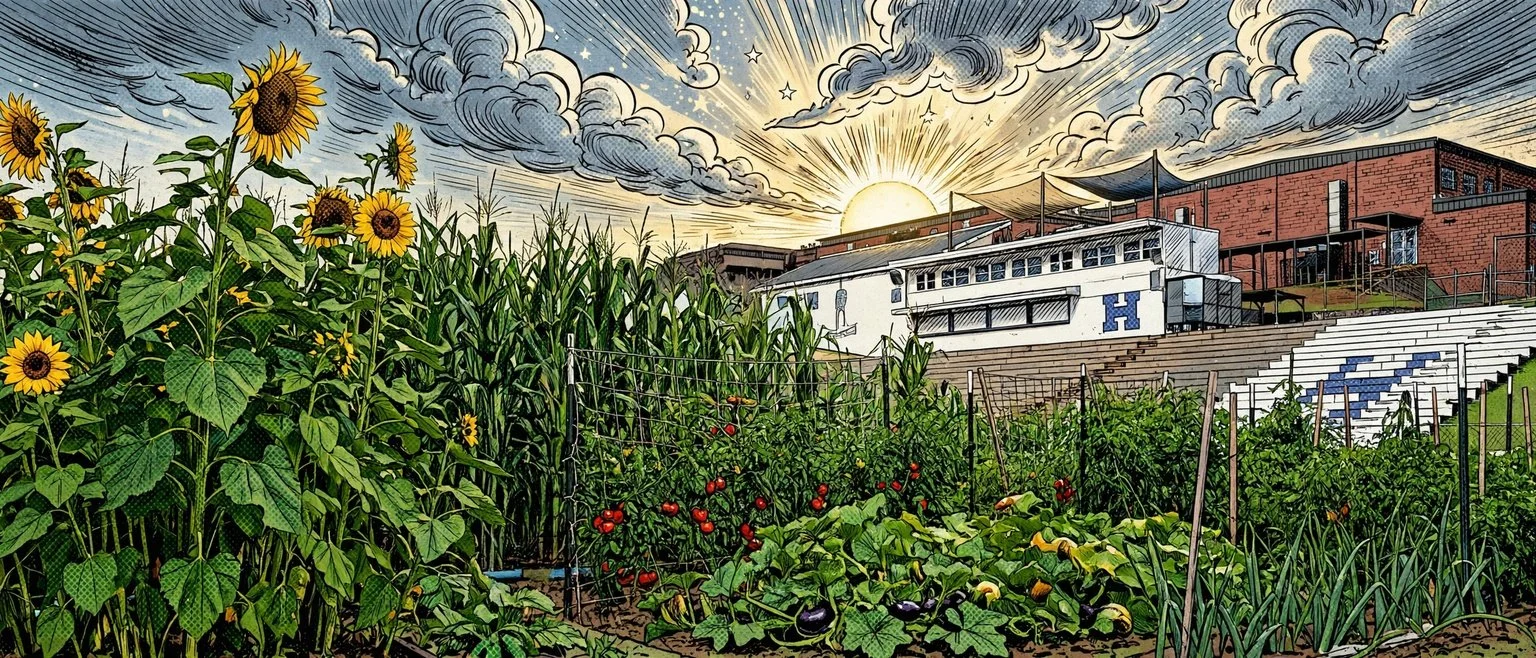
Vernon High begins to change as the survivors make it their own. Classrooms become living quarters. The football field becomes a place to grow food. That last change tells you a great deal about how far they’ve come. A football field is laid out for a game with a fixed ending. You know how much time is left, and when it runs out, everybody gets to go home. Planting a garden on that same ground means counting on still being there when something comes up.
A garden also gives people a reason to disagree about next month. How much space should they plant? How much work can they spare today for food they won’t eat for weeks? Planning that far ahead is an act of hope, but I doubt it feels particularly noble to whoever has to pull the weeds.
The work outside the school carries a different uncertainty. RED/BLUE gives the community Patrol Monitors and Supply Runners, jobs with names plain enough to tell you what people are counting on them to do. That matters in a world where so much is unclear. People may have different ideas about what caused the collapse, but the work still has to get done. Somebody has to go looking for supplies. Somebody has to keep watch. Everybody else has to decide how much trust to place in the people who take those jobs.
That’s where a familiar building can become an uneasy place to read about. We already understand what a classroom door is for. Once a classroom is somebody’s home, the same door raises a different set of questions. Do you knock? Who gets to come in? How much privacy can you reasonably ask for when everyone’s safety depends on knowing what’s happening down the hall?
Augusta’s role as principal gives her a familiar place in an unfamiliar situation. A school normally has hours. At some point, the students go home, the staff go home, and whatever problem is left can wait until morning. The people at Vernon High have turned the school into the very place they would go home to. That makes the ordinary work of getting along part of the work of staying alive.
The football field is the image I’d leave you with. Even after the world has changed beyond recognition, somebody still has to decide what to plant. And once they’ve planted it, they have a reason to care what happens to that patch of ground tomorrow.
If you’d like to follow Penn and Farrah from their interrupted honeymoon into the community taking shape at Vernon High, explore RED/BLUE in Shop Books.
